Evolving Many Worlds
Open-Ended Discovery in
Petri Dish NCA
via Population-Based Training
Open-Ended Discovery · Neural Cellular Automata · Emergent Dynamics
1FLAIR, University of Oxford · 2ELLIS Institute Tübingen · 3University of Freiburg · 4Prior Labs
TL;DR
PBT-NCA is a meta-optimization framework for evolving Petri Dish Neural Cellular Automata under novelty-driven competitive pressure. Instead of collapsing into static order or noise, the system continually discovers new lifelike behaviors ranging from coordinated motion and scattering to colonization and symbiotic partitioning. By rewarding diversity within and across worlds, PBT-NCA sustains open-ended dynamics at the edge of chaos.
Emergent Dynamics
Lifelike Phenomena from Competitive Pressure
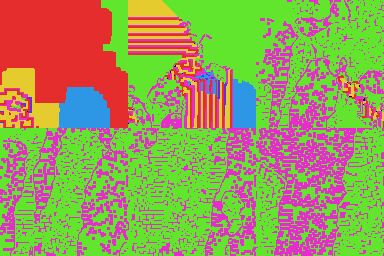
Without any handcrafted targets, PBT-NCA spontaneously evolves a diverse ecosystem of structures like shooters, gliders, amoebas, colonies, and spaceships. All arise from pure multi-agent competition.
Meta-iter 230 · 7 NCAs
Amoeba
Fluid, shape-shifting macro-structures that migrate across the substrate with coordinated. Differentiated behavior mirroring primordial multicellular organisms.
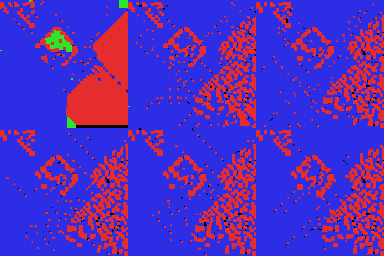
Meta-iter 20 · 3 NCAs
Shooter
Directed projectile ejected from stable territorial clusters, similar to glider-gun structures in classical CA literature.
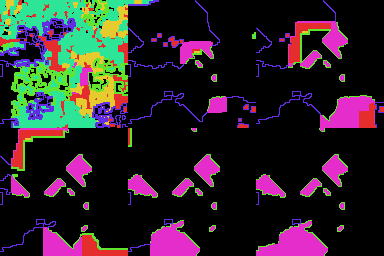
Meta-iter 460 · 7 NCAs
Glider
Persistent traveling waves that self-replicate across the grid without a fixed template, a mark of open-ended CA systems.
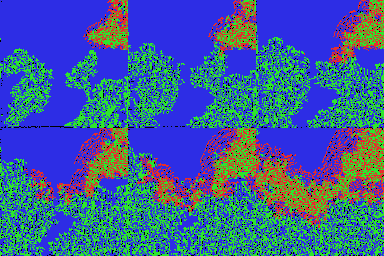
Emerging · 3 NCAs
Colony
A macroscopic entity (red) emits a small cluster of cells across the substrate to perform spatial colonization.
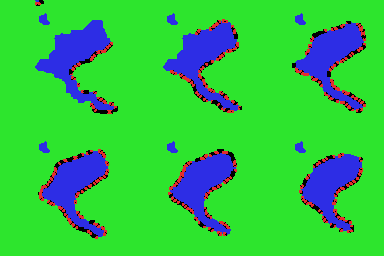
Meta-iter 370 · 3 NCAs
Ant Farm
Decentralized foraging behavior where agents shape the environment initially occupied by other passive agents.
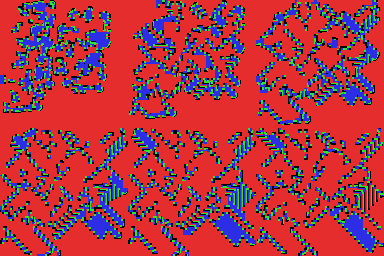
Meta-iter 20 · 3 NCAs (Extended Search Space)
Spaceship / Motherboard
Local interactions producing highly structured, periodically replicating entities with internal substructure pointing to the computational ubiquity of cellular automata.
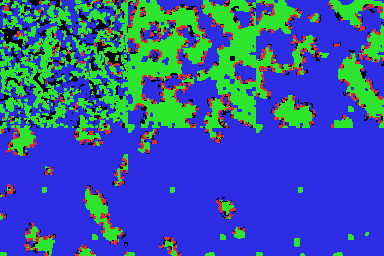
Meta-iter 125 · 3 NCAs
Archipelago
Small, persistent clusters occupying territory in real time, resembling the terraforming of an archipelago.
Evolution Timeline
Open-Ended Novelty Generation Over Meta-Iterations
This animated figure recreates the composite novelty score plot from the paper: the smoothed population novelty score grows across meta-iterations while representative emergent worlds appear at the moments they enter the evolutionary record.
Loading animated fitness figure…
Method Overview
PBT-NCA Meta-Optimization Steps
A meta-optimization loop that transforms standard population-based training into an open-ended regime discovery engine by replacing stationary fitness with novelty-driven selection pressure operating at two timescales.
01
Rollout & Score
Each of the P = 30 worlds is rolled out for Tw inner steps. Agents update via gradient-based learning while competing on the shared grid. Trajectories are scored by the dual-novelty fitness.
02
Archive Update (FIFO)
Top-m behavioral descriptors and species occupancy statistics (μ, σ, δ, entropy, alive-mass change) are appended to a bounded FIFO archive. Archive novelty is computed as k-NN distance (k = 8) in descriptor space.
03
DINOv2 Visual Diversity
Each frame is encoded by a frozen DINOv2 encoder. Per-world diversity is the median cosine distance to all other worlds at the same timestep, averaged over the rollout to reward novel morphology beyond what handcrafted descriptors capture.
04
Exploit-Explore Replacement
Every K meta-iterations, the lowest-fitness worlds are replaced by Lamarckian copies of elite parents: weights, optimizer state, and ecological context are inherited, then crossover, mutation, and Gaussian weight perturbation are applied.
Animated Meta-Iteration Overview
A browser-native walkthrough of one PBT-NCA meta-iteration: worlds are rolled out and ranked, top descriptors enter the archive, low performers are replaced, and elite copies generate new children for the next round.
1. Rollout & Score
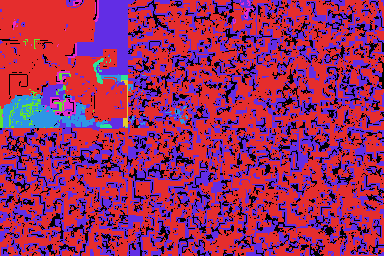
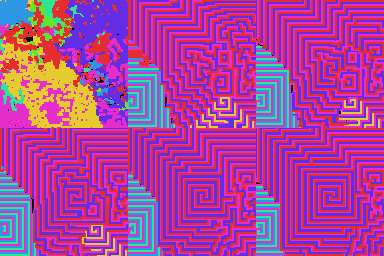
rank by novelty-driven composite score
2. Archive Update
FIFO archive update
Add the top-m behavioral descriptors from the highest-scoring worlds: 𝒜 ← 𝒜 ∪ {d₁, d₂} while maintaining a bounded first-in, first-out memory.
replace the least novel
3. Exploit–Explore
Create Offspring
Copy
Elite parent
Clone weights, optimizer state, and context.
Crossover
Mix parents
Combine strong lineages during exploit.
Mutate
Explore
Alter hyper parameters and world-level choices.
Perturb
Weight noise
Apply Gaussian noise to diversify behavior.
Child
New worlds
Spawn new worlds to replace the discarded ones.
Elite worlds seed new offsprings that inherit useful ecological context before crossover, mutation, and perturbation push them into unexplored regimes.
Next Population
Elite
Mid-rank
Low-rank
New child
Discarded
Citation
If you find this work useful, please cite the paper:
@misc{berdica2026pbtnca,
title={Evolving Many Worlds: Towards Open-Ended Discovery in Petri Dish NCA via Population-Based Training},
author={Uljad Berdica and Jakob Foerster and Frank Hutter and Arber Zela},
year={2026},
eprint={2604.11248},
archivePrefix={arXiv},
primaryClass={cs.NE},
url={https://arxiv.org/abs/2604.11248},
}
title={Evolving Many Worlds: Towards Open-Ended Discovery in Petri Dish NCA via Population-Based Training},
author={Uljad Berdica and Jakob Foerster and Frank Hutter and Arber Zela},
year={2026},
eprint={2604.11248},
archivePrefix={arXiv},
primaryClass={cs.NE},
url={https://arxiv.org/abs/2604.11248},
}